
The 33-Year Ramadan Cycle
Ramadan’s Return: Why It Comes Earlier Every Year

We are in the final few days of Ramadan. Next year at this time, Ramadan will already have been over for nearly a week. Why is that?
One of the beautiful features of Ramadan is that it arrives about 10 to 11 days earlier every year. That is because the Islamic calendar follows the lunar cycle, not the solar one. A lunar year is about 10 days shorter than a solar year, so Ramadan gradually moves backward through the seasons.
As a result, life has come full circle for me. Some of my earliest memories of Ramadan as a young child were when it fell in March and April. Now here we are again. The same month, the same spirit, the same hunger and hope—but now with the perspective of age, family, and experience.
And soon, because of this lunar rhythm, we will even have parts of two Ramadans in one calendar year. That always feels remarkable, but it also points to a deeper wisdom in how God ordained this month.
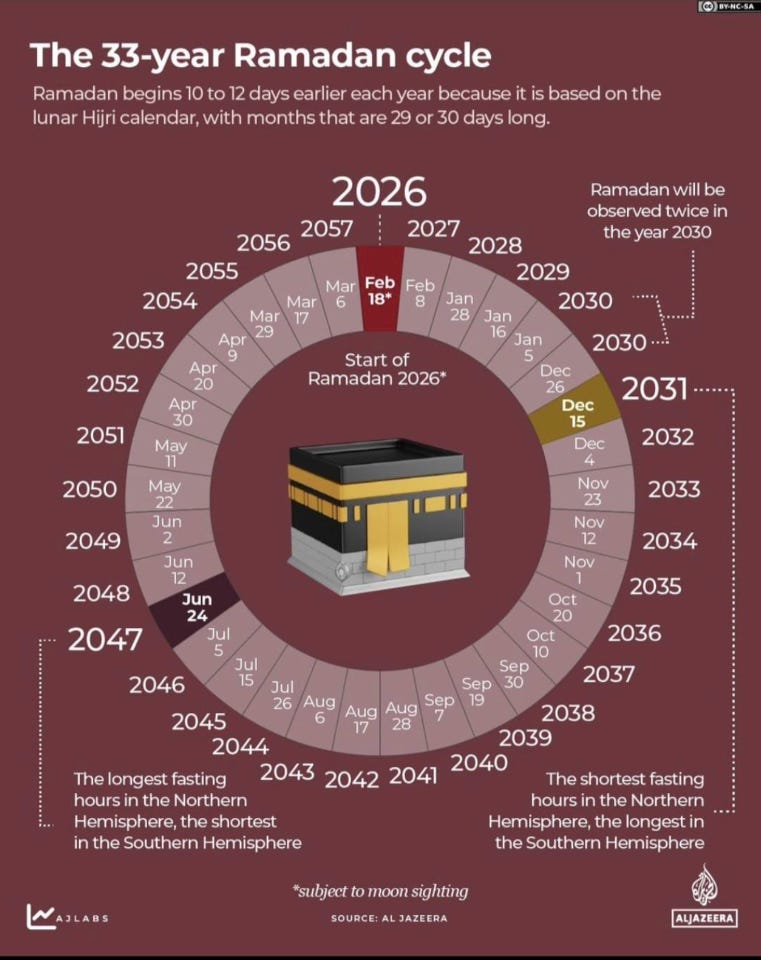
Because Ramadan rotates through the entire year, every Muslim—no matter where they live on Earth—will eventually experience it in the short, cool days of winter and in the long, demanding days of summer. When those in the northern hemisphere endure short fasts, those in the southern hemisphere endure long fasts. No one is permanently given the easiest fasts, and no one is permanently burdened with the hardest. Over time, the blessing and the struggle are shared.
There is a quiet justice in that. And perhaps also a metaphor for life itself.
Some of our struggles are short. Some are long. Some seasons feel light, and some feel heavy. But Islam teaches us that through every season, and through every fast, we rely not on ourselves alone, but on the Almighty to carry us through.
Ramadan returns each year as a reminder that time changes, seasons change, and we change. But God remains constant. And in that constancy, there is peace.

I'm learning something new every day. 🙂
I saw a joke about Ramadan, a muslim in Norway that discover that in certain parts of the country, the sun never sets during summer. But from what I understand there is different times for different regions. Who decide when you can break the fast each day if daylight doesn't dictate it?