

“Philosopher, orator, apostle, legislator, warrior, conqueror of ideas, restorer of rational dogmas, of a cult without images; the founder of twenty terrestrial empires and of one spiritual empire, that is Muhammad. As regards all standards by which human greatness may be measured, we may well ask, is there any man greater than he?”1
— Alphonse de Lamartine (1790-1869)
The United States was yet in its dawning years when, in 1854, French poet and statesman Alphonse de Lamartine penned this brilliant tribute to Prophet Muhammad (sa). While today’s western media and eastern clerics alike demonstrate ignorance to Muhammad’s (sa) magnanimous example of justice and compassion, de Lamartine struck at the core of who Muhammad (sa) was. I focus today specifically on de Lamartine’s observation that Muhammad (sa) was humanity’s greatest legislator and conqueror of ideas. And while no shortage of examples exist to demonstrate this point, I delve today in particular into the Charter of Privileges Prophet Muhammad (sa) wrote in 628 C.E. to the monks of St. Catherine Monastery in Mt. Sinai.
By 628, Muhammad (sa) was the de facto ruler of Medina. Having withstood nearly two decades of persecution and fighting in self defense for universal freedom of conscience for all people, the Muslim community had grown, strengthened, and had become highly organized. In this context, Muhammad (sa) wrote this Charter to Christians who sought his assessment on what rights they would have under Muhammad's (sa) rule. These Christians at St. Catherine’s Monastery realized they would soon have to decide how to interact with Muslims. This was no small issue, as the rule of thumb in pre-Islam Arabia was simple—when a people rule over you, they destroy your authority, usurp your rights, and implement their own model and social structure.
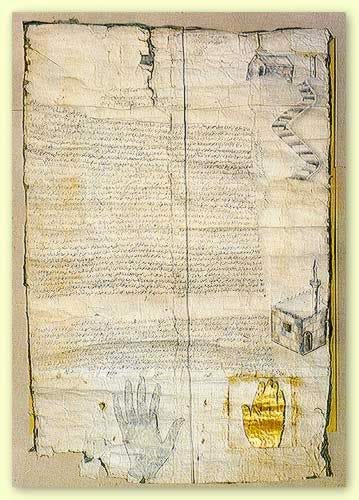
So how did Prophet Muhammad’s (sa) Charter stack up to the precedent laid out in the era before Islam? In brief, compared to world history and previous religious rules, Muhammad’s (sa) Charter was matchless. And in many ways, it remains matchless to this day compared to contemporary religious and secular countries.
Muhammad's (sa) Charter exemplified the unprecedented human rights the Qur’an established and afforded all humanity. It imbibed the timeless moral code that God set forth in the religion of Islam. And it represented a standard of ethics, morality, and freedom that even revolutionary documents like the United States Constitution have only now begun to capture.
With just eleven short provisions, the Charter encompasses an awe inspiring breadth of human rights. These rights include universal freedom of conscience, human equality regardless of religious differences, gender equity, the right to self-determination, military exemption, and a guarantee that Muslims will protect Christians from attack. Each of these provisions was unheard of pre-Islam.
For simplicity, I present each of the Charter’s eleven provisions below and describe the impact each provision had on the Christians it served. Without a doubt, Prophet Muhammad's (sa) example established a new standard of excellence and compassion. The Charter began with a resolute declaration of its author and sovereign authority.
This is a message from Muhammad (sa) ibn Abdullah, as a covenant to those who adopt Christianity, near and far, we are with them.
The Charter’s first provision establishes at least five guarantees. These guarantees form the pillars upon which Prophet Muhammad (sa) assured each additional right. First, it identifies the author as Prophet Muhammad (sa) himself. Next, it clarifies that this is not some menial letter, but a formal and binding covenant. Third, the Charter identifies Christians as the party with whom Prophet Muhammad (sa) is making the covenant. Additionally, the Charter explains that this covenant between Muhammad (sa) and Christians isn’t just for those Christians at St. Catherine’s Monastery at Sinai, but for all who adopt Christianity, “near and far.” Finally, the Charter gives glad tidings to those Christians of the covenant that “we [Muslims] are with them [Christians].” This established the unified body of Muslims and Christians as equal parties to the Charter. With this context established, the Charter begins to add crucial context.
Verily I, the servants, the helpers, and my followers defend them, because Christians are my citizens; and by Allah! I hold out against anything that displeases them.
The Charter’s second provision further clarifies what “we are with them” means. Prophet Muhammad (sa) writes that not only he, but his servants, helpers, and all Muslims defend Christians. Not content on merely stating that Muslims must defend Christians—a concept of interfaith harmony nearly unheard of in ancient times—Muhammad (sa) then develops this argument by adding a “because” clause. Thus, if anyone were to ask why Muslims should defend Christians, Muhammad (sa) himself answers, “because Christians are my citizens.” In other words, Prophet Muhammad (sa) established once and for all that any time Christians live under Muslim rule, they are citizens of Muhammad (sa) himself, and therefore must be defended against all forms of aggression. In this context Prophet Muhammad (sa) is reported to have said, “If anyone wrongs a man with whom a covenant has been made, or curtails any right of his, or imposes on him more than he can bear, or takes anything from him without his ready agreement, I shall be his adversary on the Day of Resurrection.”2
Then, by invoking the name of Allah to counter anything that so much as “displeases Christians,” Prophet Muhammad (sa) emphatically established that this Charter was not just his personal opinion, but done so with Divine authority and guidance.
The Charter’s first two provisions alone eliminate any path to persecute, censor, or discriminate against Christians. Had Prophet Muhammad (sa) stopped here, no sane person could find an excuse to violate any human right of Christians. But to ensure there remained no doubt, and to truly demonstrate that Islam’s legal rulings were far beyond anything humanity has ever seen, or seen until even this day, Prophet Muhammad (sa) continued with nine more provisions.
No compulsion is to be on them.
In crystal clear words, Prophet Muhammad (sa) condemned compulsion on Christians. In essence, this third provision is an iteration of the Holy Qur’an 2:257, “There shall be no compulsion in religion.” God revealed 2:257 after Prophet Muhammad (sa) was accepted and recognized as the de facto ruler of the State of Medina. For the first time now, Prophet Muhammad (sa) had the physical ability to finally compel Islam on all non-Muslims. Instead, God revealed “there shall be no compulsion in religion,” thereby ensuring that religious freedom shall always remain free. It is one thing to declare no compulsion when a person has no power to compel anyway, but quite another to declare no compulsion when a person is the de facto ruler—just as Muhammad (sa) was.
Moreover, the word typically translated to “religion,” is deen in Arabic. Deen’s scope is comprehensive and goes beyond mere religion. Thus, the phrase “there shall be no compulsion in religion” condemns compulsion in any and all matters of conscience. Prophet Muhammad (sa) refused to use force to spread Islam, but established a free marketplace of ideas. He conquered ideas not with force, but with better ideas.
Thus, in 628 Prophet Muhammad (sa) was the head of State of Medina, and in his capacity as head of state, included this Qur’anic provision that no compulsion is to be on Christians. And true to his style of argumentation, Prophet Muhammad (sa) did not stop at the condemnation of compulsion, but continued in subsequent Charter provisions to explain what exactly “no compulsion” meant in practical terms.
Neither are their judges to be removed from their jobs nor their monks from their monasteries.
In the fourth provision, Prophet Muhammad (sa) expanded on the previous condemnation of compulsion. He began by ensuring Christians maintained their judiciary and religious clergy, i.e the secular and religious authorities that ruled over them. In other words, Prophet Muhammad (sa) forbade any situation in which Christians lost the right to self autonomy and self decision making. On their two primary sources of authority, Christians now had the written guarantee that they would not be compelled to change or convert.
This permitted Christians to maintain their identity, security, and safety for future generations. It enabled Christians to continue to prosper according to their own terms, and without fear of oppression. It is this model to which all Muslim majority nations are obliged to follow. Those nations who restrict legal rights from Christians do so in violation of Muhammad's (sa) clear commandment. Prophet Muhammad (sa), meanwhile, next explained additional practical meanings of “no compulsion.”
No one is to destroy a house of their religion, to damage it, or to carry anything from it to the Muslims' houses.
By the fifth provision, Prophet Muhammad (sa) delved deeply into specific examples. Having established protection of the secular and religious authority of Christians, the Charter now protected all churches from attack, damage, or destruction. Continuing the argument, Prophet Muhammad (sa) specifically forbade any attempts to take material from a church to build a mosque. In his foresight, Prophet Muhammad (sa) knew a time would come when extremists ascribing to Islam would ban and destroy churches, and wanted to preemptively establish that such an act found no authority with him or in Islam.
Prophet Muhammad (sa) granted the same protection to churches as mosques. Just as the Qur’an 22:41 declared, all houses of worship were sacred and worthy of protection against attack, now the Charter additionally clarified to all Christians that according to Prophet Muhammad (sa), no Muslim could ever Islamically justify destroying a church. With the sixth provision, Prophet Muhammad (sa) emphasized one consequence to those Muslims who dared violate his covenant with Christians.
Should anyone take any of these, he would spoil God's covenant and disobey His Prophet. Verily, they are my allies and have my secure charter against all that they hate.
As with the second provision, here Prophet Muhammad (sa) once again invoked God. This further established that this Charter is not a mere man’s opinion, but that of a Prophet, and that God Himself endorses this. Muhammad (sa) reassured Christians that he will personally protect them against all they hate. Again, Prophet Muhammad (sa) reinforced that there is no compulsion by letting them decide what they like and dislike. And, that anything Christians hate, they will be protected against by Muhammad's (sa) personal and secure charter.
By calling Christians his allies, Prophet Muhammad (sa) removed any doubt and affirmed that Muslims and Christians were united. Indeed, Muhammad (sa) saw his Christian brethren as his personal responsibility to protect. He conveyed this obligation on all Muslims by warning them that disobedience to this Charter would tantamount to disobedience to himself and to God.
No one is to force them to travel or to oblige them to fight.
The seventh provision further develops the argument that Muslims must protect Christians. While Muslims and Christians both paid a tax to the government, as all citizens do, the additional benefit Christians received was military exemption. Now, Prophet Muhammad (sa) declared that not only are Christians protected, but they need not expend resources to protect themselves or fight for themselves. Instead, as they are exempt from military service, it is Muslims who must fight for Christians. Incidentally, history records numerous examples of Christians who chose to participate in military service, and thus were exempt from paying that tax. As Sir Thomas Arnold elaborates:
When any Christian people served in the Muslim army, they were exempted from the payment of this tax. Such was the case with the tribe of al-Jurajima, a Christian tribe in the neighborhood of Antioch who made peace with the Muslims, promising to be their allies and fight on their side in battle, on condition that they should not be called upon to pay jizya and should receive their proper share of the booty. When the Arab conquests were pushed to the north of Persia in A.H. 22, a similar agreement was made with a frontier tribe, which was exempted from the payment of jizya in consideration of military service. We find similar instances of remission of jizya in the case of Christians who served in the army or navy under the Turkish rule.3
By declaring that no one is to force Christians to travel, Prophet Muhammad (sa) assured Christians that they are secure in their own homes, and that Islam had no intention of establishing an exclusivist “Muslim only” nation. In essence, Muhammad's (sa) Charter built a comprehensive protection of every aspect of life for Christians. This level of respect and protection of Christians was previously unheard of, especially considering the brutal persecution through which Christians suffered for the first three hundred years after Christ.
With this provision in mind, Prophet Muhammad (sa) next obliged Muslims to fight for Christians.
The Muslims are to fight for them.
In the clearest terms, Prophet Muhammad (sa) declared that Muslims must fight on behalf of and protect Christians. Indeed, this is how allies treat one another, by being ready to sacrifice for one another’s basic freedoms. Except in this case, Prophet Muhammad (sa) declared that while Christians have no obligation or responsibility to fight for or on behalf of Muslims, Muslims have the total responsibility to fight for and on behalf of Christians. This command of Muhammad (sa) continued for centuries after his death, and when Muslims could not protect Christians, precedent exists that they were ordered to return the taxes that Christians paid.
For example, Thomas Arnold records the declaration of the great Muslim general Khalid bin Waleed: "In a treaty made by Khalid with some town in the neighborhood of Hirah, he writes; 'If we protect you, then Jizya (tax) is due to us; but if we do not, then it is not.'"4
When the famous Muslim commander of Syria, Abu Ubaida, entered the city of Hims, he made a pact with its non-Muslim inhabitants and collected the jizya tax. But this was short-lived. As he learned of the Roman emperor Heraclius’ massive advance toward the city, he knew he was outnumbered. Realizing he could no longer protect Hims or its citizens, Abu Ubaida immediately ordered the return of all taxes, stating, "We are not able to defend you anymore and now you have complete authority over your matters."5
Al-Azdi records Abu Ubaida's full statement as follows:
We have returned your wealth back to you because we detest taking your wealth and then failing to protect your land. We are moving to another area and have called upon our brethren, and then we will fight our enemy. If Allah helps us defeat them we shall fulfill our covenant with you except that you yourselves do not like it then.6
In this powerful testimony, Abu Ubaida made clear that Muslims had no desire to forcefully rule over Christians, as indicated by the phrase “except that you yourselves do not like it.” Instead, the covenant with Christians was a mutual and just treaty. This is the understanding that the people of Hims held, as demonstrated in their reply to Abu Ubaida. Their reply is documented, and demonstrats the compassionate model Prophet Muhammad (sa) established in his Charters with non-Muslims. The people of Hims replied:
Verily your rule and justice is dearer to us than the tyranny and oppression in which we used to live.7 May God again make you ruler over us and may God's curse be upon the Byzantines who used to rule over us. By the Lord, had it been they, they would have never returned us anything; instead they would have seized all they could from our possessions.8
This testimony additionally describes what the customary injustice meted out by ruling authorities. The example Prophet Muhammad (sa) established was unprecedented with a “rule and justice” so dear that they awaited the day for such rule to return. With this new level of magnanimity, Prophet Muhammad (sa) established a new precedent of international alliance in ancient times.
Delving deeper into specific examples of rights for Christians, Prophet Muhammad (sa) then turned to the rights of Christian women.
If a female Christian is married to a Muslim, it is not to take place without her approval. She is not to be prevented from visiting her church to pray.
Islam had already declared that Muslim women had equal and equitable rights to that of Muslim men. Islam was the first religion to ensure women had full choice on marriage, divorce, and owning property. Sensitive to the reality of social interaction between Muslims and Christians, Prophet Muhammad (sa) included this ninth provision to ensure Muslims understood that Christian women maintained equitable rights as Muslim women, while maintaining their faith as Christians.
In particular, a Christian woman could not be forced into marriage. Contrary to the barbarity of Daesh terrorists who attempted to justify rape of Christian women, Prophet Muhammad's (sa) clear commandment to the contrary provides no justification. In wholly condemning all forms of coercion upon Christian women, Prophet Muhammad (sa) rebuked any attempt to compel any belief or action upon Christian women.
Moreover, in ensuring Christian women had both autonomy and freedom of religion, Prophet Muhammad (sa) ensured that no Christian woman would ever face restriction in travel and worship. Once again, by ensuring universal freedom of conscience and the right to autonomy to Christian women, Prophet Muhammad's (sa) charter advanced the rights of women to new heights.
These rights extended beyond individual Christians, and encompassed the entire Christian faith, as Prophet Muhammad (sa) elaborated in the tenth provision.
Their churches are to be respected. They are neither to be prevented from repairing them nor the sacredness of their covenants.
While the fifth provision forbade destroying churches, the tenth provision goes further and commands Muslims to respect churches. This critical addition ensured ongoing respect for Christians and their churches. In other words, beyond the legal responsibility to protect churches from attack, Muslims now had an ethical and moral responsibility to respect churches and recognize their sacredness. This repeated emphasis was critical as we see that in the middle ages, some jurists started innovating some restriction on churches. Even now we see some clerics from Saudi Arabia who seek to obliterate churches from the Arabian Peninsula. In both such cases, Prophet Muhammad (sa) preemptively forbade such restrictions and destructions.
Implicit in this provision that Christians “are [not] to be prevented from repairing them” is the fact that Christians had the ability to earn in trade and commerce to afford repairing Churches. Indeed, Islam advocates economic justice for all citizens. Here, Prophet Muhammad's (sa) charter further ensured that Christians were empowered to use their economic means to maintain and repair their churches, and that Muslims were obliged to respect such acts.
Prophet Muhammad's (sa) final provision obliterates any attempt to remove this charter’s contemporary applicability.
No one of the nation (Muslims) is to disobey the covenant till the Last Day (end of the world).
Prophet Muhammad's (sa) final provision ensured no Muslim could claim his commandments had expired. Indeed, by stating no one of the nation of Muslims is to disobey this covenant until the Last Day, i.e. The Day of Judgement at the end of time, Prophet Muhammad (sa) established that should any state ever claim to follow Islam, the above ten provisions apply to that state with full authority.
This meant Christians living under Muslim rule would maintain universal freedom of conscience, protection from all compulsion, protection from all attack, protection from economic harm, Christian women would maintain autonomy and could not be compelled into marriage, maintain their religious and secular courts, and ensure protection against all they hate. Prophet Muhammad (sa) is reported to have said, “Whoever killed a Mu'ahid (a person who is granted the pledge of protection by the Muslims) shall not smell the fragrance of Paradise though its fragrance can be smelt at a distance of forty years (of traveling).”9
Prophet Muhammad's (sa) commandments lived on through the rightly guided Caliphs after his demise. When Khalifa Umar became the ruler of Jerusalem, he entered into a pact with all inhabitants of the city, declaring:
In the name of Allah, the most Gracious, most Beneficent. This is a covenant of peace granted by the slave of Allah, the commander of the faithful 'Umar to the people of Jerusalem. They are granted protection for their lives, their property, their churches, and their Crosses, in whatever condition they are. All of them are granted the same protection. No one will dwell in their churches, nor will they be destroyed and nothing will be reduced of their belongings. Nothing shall be taken from their Crosses or their property. There will be no compulsion on them regarding their religion, nor will any one of them be troubled.”10
Khalifa Umar valiantly advanced the same compassionate model that Prophet Muhammad (sa) established. Turning to contemporary times, it wasn’t until over 1200 years later, upon the writing of the United States Constitution, that similar rights were granted to people, minorities or otherwise. And even then, in the United States, slavery was the status quo, women could not own property or have full self determination, and religious minorities were heavily persecuted. Jews were exiled, Mormons and Catholics were brutally massacred on multiple occasions, Native Americans suffered horrific genocide, and Africans were enslaved by the millions.
In leading by example, however, Prophet Muhammad (sa) ensured that his Charter with Christians would give practical effect, and not just dissipate in theory. And we know this Charter was effective for two reasons. First, it survives to this day in its authentic form. Second, and perhaps most importantly, the St. Catherine’s Monastery at Sinai survives to this day, untouched and unharmed. He established a powerful law and spread it with argumentation and better ideas—never force.
This covenant that Prophet Muhammad (sa) made with Christians “near and far,” is a sacred and inspiring reminder of the power of unity for the sake of justice and humanity. Prophet Muhammad (sa) is every bit humanity’s greatest legislator and conqueror of ideas, as Alphonse de Lamartine eloquently wrote in 1854. May we learn to imbibe his noble principles of absolute justice, secular governance, and universal freedom of conscience for all people. Ameen.
Translated from Histoire De La Turquie, Paris, 1854, vol. II, pp. 276-277
Sahih Sunan Abu Dawud, #3052.
Thomas Walker Arnold, The Preaching of Islam: A History of the Propagation of the Muslim Faith (2007) 61-62.
Arnold, The Preaching of Islam, 6.
William N. Lees, Futuh ash-Sham ed. (Culcutta: Baptist Mission, 1854), 1/162.
Ibid. 137-38.
Ibid., 1/162.
Ibid., 138.
Sahih Jami' Bukhari, vol. 9, Book 83, #49.
Tarikh at-Tabari, 2/308.
As a member of the Christian clergy, I am deeply appreciative of this piece. I had not heard of this remarkable letter before. It provides so much background to the relationships I have with Muslim leaders, which are characterized by profound respect.
A poster of the letter prominently displayed in my office wouldn't be terribly respectful of Islamic tradition, would it?