
Has the Qur’an Ever Been Changed?
Addressing the claim from critics that the Qur'an has been abrogated over time.

A common claim made by critics of Islam is the theory of Qur’anic abrogation — the idea that later verses in the Qur’an override earlier ones, allegedly creating contradictions that Muslims cannot reconcile. Some critics go further and allege multiple different versions of the Qur’an exist. Some yet go even further and claim that we cannot possibly know which version of the Qur’an is the “true revealed” version, as it has somehow been lost to the ages. In reality, none of these claims hold any water, and the evidence to the contrary is absolutely overwhelming.
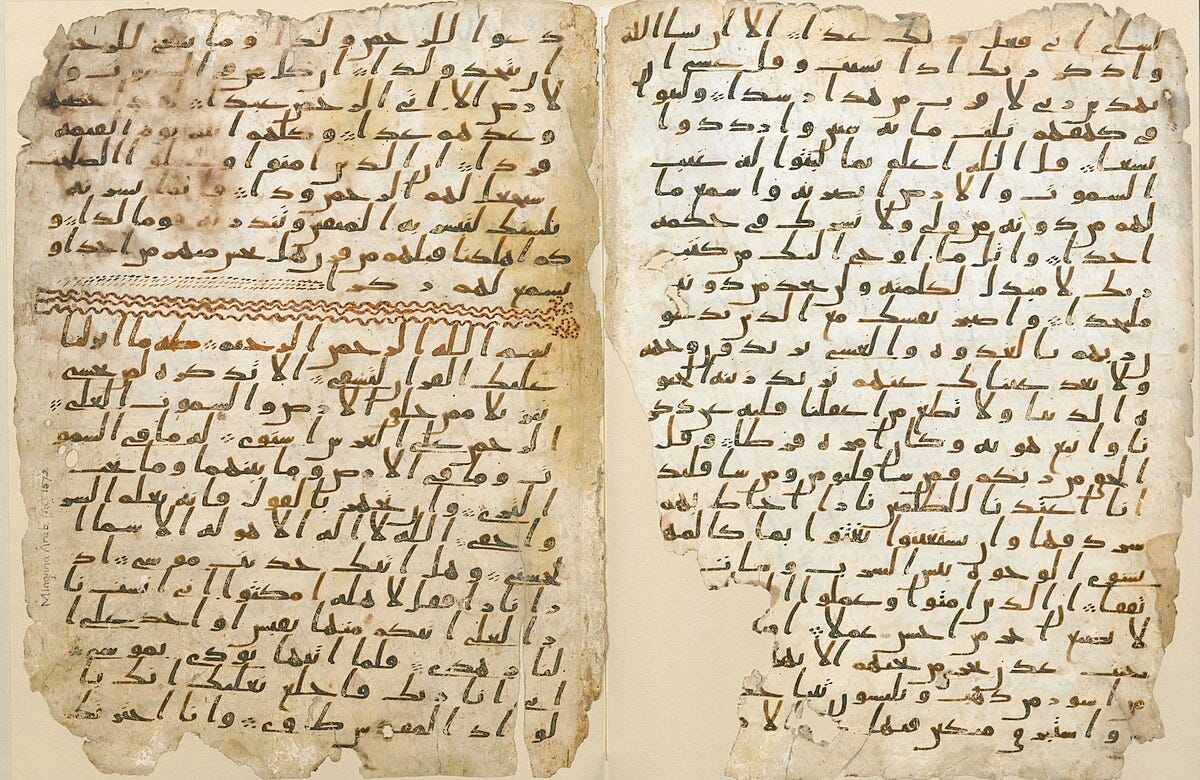
In this piece I establish the critical points that the Qur’an has never been changed, only one version of the Arabic text exists, and we know this through numerous sources of evidence, including the fact that original manuscripts of the Qur’an from the time of Prophet Muhammad (sa) exist to this day. Ignoring all this evidence, one prominent critic of Islam writes regarding alleged contradictions in the Qur’an:
“Muslims later became embarrassed by these contradictions between earlier and later Koranic verse. Islamic theologians solved this problem with the concept of an-Nasikh wal mansukh (‘the abrogating and the abrogated’). According to this concept, whenever there are contradictions in the Koran, later verses overrule earlier ones; in other words, Allah revoked what he had earlier revealed. This means, in effect, that the earlier verses speaking favorably of Jews and Christians are overruled by later, hostile verses, and that tolerant verses are overruled by intolerant ones.”
The critic continues by quoting Pope Benedict XVI to support this argument:
“According to some of the experts, this is probably one of the suras of the early period, when Muhammad was still powerless and under threat.” The Pope then adds that these verses are “contradicted… by the instructions, developed later and recorded in the Koran, concerning holy war.”
Unfortunately, both the aforementioned critic and the late Pope couldn’t be more wrong in their claims. Such critics never provide actual evidence for their claims, because no such evidence exists. And while I don’t expect ignorant critics to uphold truth and honesty, I was disappointed to see the late Pope disseminate disinformation.
A Baseless Theory Without Evidence
Not surprisingly, this critic — who has no formal training in Qur’anic hermeneutics — provides no references or sources to substantiate their claims. In reality, the theory of Qur’anic abrogation lacks any scriptural merit. I draw your attention to three critical points.
First, the Qur’an itself outlines its method of interpretation: it contains verses that are “firm and decisive in meaning” (muhkamaat) and others that are allegorical or open to interpretation (mutashaabihaat):
“He it is Who has sent down to thee the Book; in it are verses that are clear and decisive—they are the basis of the Book—and others that are susceptible of different interpretations…”
(Qur’an 3:8)
When interpreting the Qur’an, decisive verses take precedence in meaning and are used to interpret the ambiguous—not to cancel or “abrogate” them. If an interpretation of an ambiguous verse contradicts a clear one, it is the interpretation that is rejected — never the verse itself.
This method is deeply consistent with the Qur’anic spirit, which repeatedly emphasizes reason and reflection. The Qur’an implores believers:
“There is no compulsion in religion...”
(Qur’an 2:257)
I’ve shared this verse before, and it is profound in its application here. Truth does not require compulsion. It does not require logical pretzels. It only requires full and honest analysis and display, and the logic reveals itself quite clearly.
“Those who remember Allah while standing, sitting, and lying on their sides, and ponder over the creation of the heavens and the earth…”
(Qur’an 3:191–192)
Here, God calls on people to ponder and reflect. These are commandments to investigate and think critically, not to believe blindly.
“And We gave understanding of the case to Solomon...”
(Qur’an 38:30)
Again, God gives the example of Prophet Solomon (as) to demonstrate how we should behave. “Understanding of the case” by definition speaks to the importance of logical thinking, using our intellect and rationale, and demanding clarity while rejecting contradictions.
Prophet Muhammad’s Guidance on Interpretation
Two, a moment ago I pointed out that “If an interpretation of an ambiguous verse contradicts a clear one, it is the interpretation that is rejected — never the verse itself.” This is not my opinion, but literally what Prophet Muhammad (sa) advised on how to properly interpret the Qur’an. He warned against interpreting scripture in a way that leads to contradictions:
“Thus were ruined those who have gone before you. They interpreted certain parts of their scriptures in such a manner as to make them contradict other parts. But the Qur’an has been so revealed that different parts of it corroborate one another. So do not reject any truth by making one part contradict the other. Act on what you understand thereof and refer that which you do not understand to those who know and understand it.”
(Musnad Ahmad bin Hanbal, Hadith no. 6741)
When the person to whom the Qur’an is revealed is himself explaining how the Qur’an should be understood, we would do well to listen to that advice.
The Verse on Compulsion Was Revealed Later
And three, the Pope’s claim that “there is no compulsion in religion” was revealed in early Islam when the Prophet was weak is simply false. This verse was revealed after Prophet Muhammad (sa) migrated to Medina and had political and military authority — not before. In fact, most of the Qur’an’s chapters addressing Jews, Christians, apostasy, jihad, and justice were revealed in Medina, not Mecca. It is critical to understand this point. One of the main claims critics espouse is that when Muslims were politically weak, the Qur’an revealed verses speaking favorably about Jews and Christians to win favor. But when Muslims became politically powerful, the Qur’an then allegedly revealed verses to the contrary.
But in fact, the exact opposite is true. When Muslims were weak, the Qur’an spoke clearly about theological differences between Muslims and Christians and Jews, while still referring to Jews and Christians with the honorable title of “People of the Book.” And once Muslims gained military power and strength, the Qur’an then explicitly commanded Muslims to remember, “There shall be no compulsion in religion.”
Indeed, given that the verse prohibiting religious compulsion came after the Prophet gained power, it only proves that Islam reaffirmed tolerance even when it could have done otherwise. Far from being “abrogated,” this verse refutes the theory entirely.
Conclusion: One Qur’an, Preserved Since Day One
The Qur’an does not contradict itself, nor does it contain abrogated verses that override its teachings. What some label “abrogation” is often just misunderstanding of context or failure to grasp the layered nature of its message. When one honestly reads the Qur’an — whether on self-defense, apostasy, Jews and Christians, jihad, or jizya — it becomes clear that these teachings function in harmony, not in contradiction. Islam’s legal and ethical framework is contextual and consistent — not contradictory.
Finally, critics who rely on these claims of abrogation fail to recognize the miracle of preservation that the Qur’an embodies. For over 1,400 years, the Qur’an has remained unchanged, with only one version in Arabic, memorized and recited by millions around the world. No other book in human history has enjoyed such unanimous preservation across language, geography, and time. Indeed, beyond memorization, to this day we have physical copies of the Qur’an from the lifetime of Prophet Muhammad (sa) and the four Caliphs who succeeded him.
This is perhaps the greatest evidence that the Qur’an has never been altered — not a word, not a verse. A Book that is unchanged needs no revision. A truth that is eternal needs no abrogation.
References
Qur’an 3:8
Qur’an 2:257
Qur’an 3:191–192
Qur’an 38:30
Musnad Ahmad bin Hanbal, Hadith no. 6741 — in Musnad Abdullah bin Amr bin al-Aas, Beirut: Alim ul Kutab, 1998
Imam Mukhtar Cheema, “A Rejoinder to the Pope’s Allegations Against Islam,” alislam.org
Whether God spoke to Moses from the midst of a burning bush, Jesus from a mountain top or Mohammed from inside a cave with scribes in attendance, I’m going with the primary sources from the cave. And that still doesn’t mean I agree with everything Mohammed said that Allah revealed to him. It just means my understanding of the Q’aran is as clear to me today as it was to anyone the day it was written. No one can say that about either the Old or New Testaments, with their many iterations and translations.
It is hard to imagine that one man could create the most comprehensive manual for self improvement and societal governance in a single draft without intense and detailed observation.
Among the few advanced luminaries, Prophet Muhammad (sa) insisted that we accept nothing on faith that we have not sufficiently proven to ourselves to be true. Whether the text was dictated by God makes it no less relevant to Being Here.